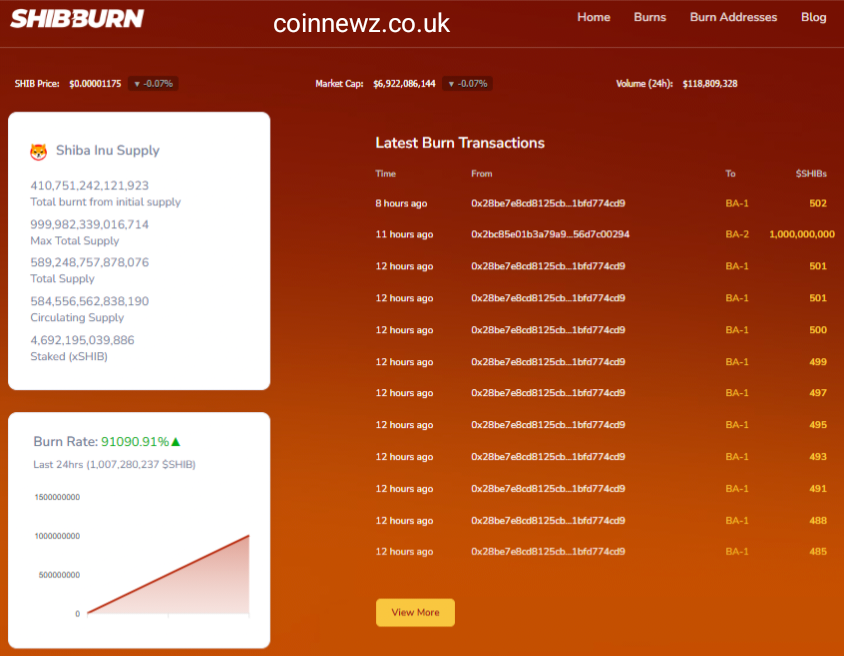
Shiba Inu Tokens Destroyed: 7 Powerful SHIB Burn Facts That Could Impact Price
Shiba Inu remains one of the most closely watched meme cryptocurrencies, and the number of Shiba Inu tokens destroyed continues to attract attention from investors and the wider crypto community. Token burning is an important part of the SHIB ecosystem because it permanently removes tokens from circulation, creating a deflationary effect over time.
The idea is straightforward: SHIB tokens are sent to addresses from which they cannot be recovered or spent. Once a token reaches such an address, it is effectively removed from the usable supply. Shiba Inu’s official ecosystem describes SHIB as having a deflationary element supported by community activity, organic transaction burns and ShibTorch.
But burning tokens does not automatically mean that the SHIB price will rise. The real impact depends on the amount destroyed, the remaining supply, demand for SHIB, market conditions, adoption of the ecosystem and the long-term growth of Shibarium.
This guide explains how Shiba Inu tokens destroyed work, why SHIB holders care about burns, how Shibarium contributes to the process, and what investors in the United States and United Kingdom should understand about the relationship between token supply and price.
What Does Shiba Inu Tokens Destroyed Mean?
The phrase Shiba Inu tokens destroyed refers to SHIB tokens that have been permanently removed from circulation.
In cryptocurrency, this process is generally called a token burn. Instead of keeping tokens in a normal wallet where they could eventually be sold or transferred, tokens are sent to a burn address or otherwise processed through a mechanism designed to make them permanently inaccessible.
The purpose is to reduce the number of tokens available in the market.
For example, imagine a cryptocurrency has 100 trillion tokens in circulation. If 1 trillion tokens are permanently destroyed, the theoretical circulating supply could fall to 99 trillion, assuming all other supply variables remain unchanged.
The important point is that a burn does not simply move tokens from one investor to another. Properly executed burns remove tokens from practical circulation.
Shiba Inu’s official documentation identifies SHIB as a deflationary token supported by community burns, organic burns and ShibTorch.
However, investors should distinguish between tokens destroyed and tokens transferred. A normal wallet transfer does not reduce supply. A token sent to another exchange or investor is still part of the ecosystem’s available supply. A genuine burn permanently removes the tokens from use.
How Are Shiba Inu Tokens Destroyed?
There are several ways SHIB can be removed from circulation.
One of the most important developments has been the integration of burn mechanisms with Shibarium, Shiba Inu’s Layer 2 blockchain.
Shibarium uses BONE as its gas token. Under the burn mechanism introduced for the network, a portion of eligible transaction fees can accumulate for the burning process. Shiba Inu’s ecosystem documentation now provides a Shibarium burn interface and describes the process of converting accumulated BONE for SHIB burning.
The basic concept is:
- Users make transactions on Shibarium.
- Transaction activity generates fees.
- A portion of the applicable fee can accumulate for the burn mechanism.
- BONE can be used in the burn process.
- SHIB is purchased or otherwise processed for destruction.
- The resulting SHIB is permanently removed from circulation.
This creates a potential connection between actual blockchain activity and SHIB burns.
That distinction is important. A burn mechanism based on network activity can potentially become more meaningful as the underlying ecosystem attracts more transactions and users.
Community Burns
Community participation is another major part of SHIB’s burning culture.
Individual holders, projects and community participants can voluntarily destroy SHIB. ShibTorch provides an official mechanism for participating in burns and tracking burn activity. The official Shibarium burn page displays burn activity and transaction information.
Historically, individual burn transactions have sometimes produced large short-term increases in the reported burn rate. For example, The Shib Daily reported that more than 225 million SHIB were burned in one transaction in June 2024, contributing to a large daily burn-rate increase.
These events can attract attention, but one unusually large burn should not automatically be interpreted as a fundamental change in SHIB’s economics.
Why Are Shiba Inu Tokens Destroyed?
The primary reason for destroying SHIB is to reduce the token supply.
Like other assets, SHIB’s market price is influenced by supply and demand. If demand remains constant while the available supply decreases, scarcity can theoretically increase.
However, the relationship is not automatic.
Suppose a project destroys millions of tokens but demand falls significantly at the same time. The lower supply alone may not be enough to push the price higher.
That is why investors should look at both sides of the equation:
Supply: How many SHIB tokens are being removed?
Demand: How many people want to hold, use or purchase SHIB?
A sustainable increase in SHIB’s value would generally require more than token burns. It would require continued demand, liquidity, ecosystem development and broader market support.
The Shiba Inu ecosystem itself presents burns as part of a broader deflationary strategy rather than as a guaranteed price mechanism.
Shibarium and the SHIB Burn Mechanism
Shibarium has become particularly important in discussions about Shiba Inu tokens destroyed.
The Layer 2 network was developed to support activity within the Shiba Inu ecosystem while making transactions more practical. Its burn mechanism creates a connection between network usage and SHIB supply reduction.
A 2024 Shibarium upgrade introduced a mechanism in which 70% of eligible base transaction fees were designated for conversion into SHIB and permanent removal from circulation, while the remaining portion supported network maintenance and ecosystem development.
The broader objective is significant because it attempts to make burns part of the network’s infrastructure rather than relying exclusively on voluntary community transactions.
In theory, increased Shibarium activity could lead to greater fee generation. If the burn mechanism processes more fees, that could lead to more SHIB being destroyed.
However, this should not be confused with a guaranteed price increase.
Higher transaction activity can contribute to greater burns, but the market price still depends on demand, investor sentiment, Bitcoin and broader crypto-market conditions, liquidity and many other factors.
ShibTorch and Tracking Destroyed SHIB
Tracking burns is important because investors need to know whether claims about destroyed tokens are supported by blockchain activity.
ShibTorch is designed to provide greater visibility into the burn process. The official Shiba Inu ecosystem provides a burn tracker showing completed and ongoing burn activity.
This is useful because social media posts can sometimes highlight dramatic burn percentages without explaining the actual number of tokens involved.
For example, a burn rate might increase by hundreds or thousands of percent compared with a previous period. That sounds enormous, but the underlying number could still represent a relatively small percentage of SHIB’s overall supply.
Therefore, investors should look beyond the percentage increase.
When researching Shiba Inu tokens destroyed, consider:
- The actual number of SHIB burned
- The time period involved
- The circulating supply
- The percentage of supply removed
- Whether the burn was a one-time event or part of an ongoing process
- The source of the burn
- Whether the transaction can be verified on-chain
This provides a much clearer picture than simply looking at a headline about a huge burn-rate increase.
Does Burning SHIB Increase Its Price?
This is one of the most common questions surrounding Shiba Inu tokens destroyed.
The short answer is: burning can reduce supply, but it does not guarantee a higher price.
The economics can be explained simply.
If fewer tokens are available and demand remains strong, scarcity can increase. That can potentially support a higher market price.
But if demand declines, the reduction in supply may have little visible effect.
Consider two hypothetical situations.
Scenario One: Supply Falls and Demand Rises
Suppose a large number of SHIB tokens are destroyed while more people begin using the Shiba Inu ecosystem. New buyers enter the market and existing holders continue holding their tokens.
In that situation, reduced supply combined with stronger demand could create upward pressure on price.
Scenario Two: Supply Falls but Demand Declines
Now suppose millions or billions of SHIB are destroyed, but the crypto market enters a prolonged downturn and investors sell riskier assets.
Even with fewer tokens available, weaker demand could push the market price lower.
This is why token burns should be considered one part of SHIB’s broader economic model rather than a standalone price prediction tool.
How Significant Are SHIB Burns?
The significance of a burn depends on its size relative to the total supply.
This is especially important for Shiba Inu because SHIB has historically had an extremely large token supply.
A burn involving millions of tokens may sound substantial, but the percentage impact can be very small when compared with the total amount of SHIB.
For this reason, investors should avoid judging a burn solely by the number of tokens destroyed.
A better approach is to ask:
What percentage of the relevant supply has actually been removed?
That gives a more meaningful indication of scarcity.
The historical record illustrates this point. The Shib Daily reported that more than 30 million SHIB were burned over a 24-hour period in February 2025, while more than 142 million were reportedly burned over seven days. The article described the event as a significant short-term increase in the burn rate, but the economic significance still needs to be considered relative to SHIB’s enormous supply.
Can SHIB Burns Make Shiba Inu Scarce?
In principle, continuous token destruction can make an asset more scarce.
But scarcity alone does not create value.
For SHIB to benefit meaningfully from long-term supply reduction, the ecosystem would ideally need continued or increasing demand.
That demand could potentially come from:
- Shibarium usage
- Ecosystem applications
- Community participation
- Payments and other utility
- Decentralized finance activity
- Gaming and metaverse applications
- Investor interest
- Broader cryptocurrency adoption
The official SHIB ecosystem describes the token as having roles across parts of its broader ecosystem, including gaming and other applications, while also highlighting its deflationary characteristics.
Therefore, the long-term story is not simply about how many tokens are burned. It is about whether SHIB can develop enough utility and demand to make the declining supply economically meaningful.
Why Burn Rate Headlines Can Be Misleading
Crypto websites and social media accounts often report large percentage increases in the SHIB burn rate.
For example:
“SHIB burn rate jumps 1,000%.”
At first glance, this may look extremely bullish.
But investors should ask what the percentage is being compared with.
If the previous period had an unusually low number of burns, even a relatively modest increase can create a huge percentage change.
This is why absolute SHIB destroyed and percentage of total supply removed are often more useful measurements.
A responsible SHIB analysis should provide context rather than focusing only on the largest percentage number.
What Should SHIB Investors Watch?
Anyone researching Shiba Inu tokens destroyed should monitor several factors rather than burns alone.
1. Burn Volume
Look at how many SHIB tokens were actually destroyed during a specific period.
2. Burn Frequency
A consistent burn mechanism may be more meaningful than isolated community transactions.
3. Shibarium Activity
Increasing network usage could potentially create more activity around the ecosystem’s burn mechanism.
4. Circulating Supply
The percentage of supply removed matters more than a large raw number by itself.
5. Demand
This is arguably just as important as supply. More burns without new demand may have limited impact.
6. Market Conditions
SHIB remains part of the broader cryptocurrency market. Bitcoin’s direction, liquidity, investor sentiment and macroeconomic conditions can all influence altcoins.
7. Ecosystem Development
Long-term utility may be more important than short-term burn headlines.
Could Shiba Inu Reach a Much Higher Price Through Burns?
The possibility of a higher SHIB price is often discussed alongside extremely large future burn scenarios.
However, investors should be careful with simplistic calculations.
For example, saying that burning a certain number of SHIB automatically means the token will reach a particular price ignores market capitalization, demand and the remaining supply.
A useful calculation is:
Market Capitalization = Token Price × Circulating Supply
If SHIB’s supply remains enormous, reaching a very high per-token price would require a correspondingly large market capitalization unless the supply is reduced dramatically.
Therefore, anyone making a prediction about SHIB should consider both price and supply rather than focusing on price alone.
Burns can contribute to a lower supply over time, but the pace and scale of destruction matter.
Are Shiba Inu Token Burns Good for Long-Term Holders?
Potentially, but there are no guarantees.
Long-term holders may view burns positively because permanent supply reduction can strengthen the scarcity component of the token’s economics.
However, holders should not assume that every burn will produce an immediate price increase.
The value of SHIB depends on much more than its supply.
A stronger long-term case would involve several developments occurring together:
- Continued token burns
- Growing Shibarium activity
- More ecosystem utility
- Stronger user adoption
- Sustainable demand
- Healthy liquidity
- Continued developer activity
- Favorable cryptocurrency market conditions
Burns are therefore best viewed as one component of a larger ecosystem strategy.
Shiba Inu Tokens Destroyed: What the Data Really Tells Investors
The most important lesson is that not all burn statistics mean the same thing.
A burn announcement can be useful, but investors need context.
Suppose one report says:
“100 million SHIB destroyed.”
That sounds significant.
But if another report says:
“100 million SHIB represents only a tiny fraction of the circulating supply,”
the second statement gives investors more useful information.
Similarly, a 2,000% increase in the burn rate can sound extraordinary even when the underlying quantity is relatively small.
The best analysis therefore combines:
Burn amount + supply percentage + burn frequency + network activity + demand + market conditions.
This approach can help investors avoid reacting emotionally to individual burn headlines.
FAQ’s
About Shiba Inu Tokens Destroyed
How are Shiba Inu tokens destroyed?
SHIB can be permanently removed from circulation by sending tokens to burn addresses or through ecosystem mechanisms designed to destroy SHIB. Shibarium also supports a burn process connected with network fees.
What happens when SHIB tokens are burned?
Burned tokens are permanently removed from practical circulation. They cannot normally be recovered or spent, which reduces the available supply.
Does burning SHIB increase its price?
Not automatically. Burns reduce supply, but price also depends heavily on demand, market conditions, liquidity, adoption and investor sentiment.
What is ShibTorch?
ShibTorch is an official Shiba Inu ecosystem interface designed to facilitate and track SHIB burning activity. The current Shibarium burn page provides information about burn activity and the process.
Does Shibarium burn SHIB?
Yes. Shibarium has a burn mechanism connected with eligible transaction fees. The mechanism is designed to convert part of the fee value into SHIB and permanently remove those tokens from circulation.
Why does Shiba Inu burn tokens?
The main objective is to reduce the circulating supply and increase scarcity over time. The long-term economic effect depends on how supply reduction interacts with demand.
Can SHIB burns make the token valuable?
Burns can contribute to scarcity, but they cannot guarantee a higher market value. Demand and utility remain critical.
Where can investors track SHIB burns?
The official Shiba Inu ecosystem provides a Shibarium burn tracker through ShibTorch, allowing users to view burn activity.
Conclusion:
The number of Shiba Inu tokens destroyed remains an important metric for anyone following SHIB and its long-term tokenomics. Burns permanently remove SHIB from circulation and can contribute to a more deflationary supply structure.
Shibarium has made the subject even more important by connecting part of the burn process with blockchain activity. The official ecosystem also provides ShibTorch and a burn tracker to improve visibility into the process.
Still, investors should avoid assuming that every large burn will immediately increase SHIB’s price. The real economic impact depends on the scale of the burn relative to supply, the frequency of future burns, Shibarium adoption, ecosystem utility and overall demand for SHIB.
For readers in the United States, United Kingdom and elsewhere, the most useful approach is to look beyond headlines and examine verifiable burn data, circulating supply and broader market conditions.
Ultimately, SHIB’s future will depend not only on how many tokens are destroyed, but also on how much real demand the ecosystem can create. Burns can reduce supply, but sustainable demand is what can turn scarcity into meaningful market value.
Meta Description:
Discover 7 powerful facts about Shiba Inu tokens destroyed, how SHIB burns work, why they matter, and what massive token burns could mean for price.