ZK Rollup News: 7 Powerful Trends Shaping Ethereum Scaling in 2026
The latest zk rollup news shows that zero-knowledge technology is moving from an experimental scaling concept toward a more mature part of the Ethereum ecosystem. ZK rollups are designed to process transactions away from Ethereum Mainnet while using cryptographic validity proofs to verify that those transactions were executed correctly. Ethereum’s own documentation describes ZK rollups as Layer 2 systems that move computation and state storage off-chain, batch transactions, and submit compressed information plus proofs back to Ethereum.
In 2026, the conversation around ZK rollups is becoming broader. Developers are no longer focused only on transaction speed and lower fees. Attention is also shifting toward proving efficiency, zkEVM compatibility, security verification, decentralization, interoperability, and how ZK technology can support increasingly sophisticated applications.
For users and investors in the United States following blockchain developments, these changes are important because Layer 2 infrastructure could influence how people interact with decentralized finance, gaming, payments, tokenized assets, and other blockchain applications.
Here are seven major zk rollup news trends worth watching in 2026.
1. ZK Rollups Are Becoming a Major Ethereum Scaling Strategy
Ethereum has historically faced a fundamental scalability challenge. When demand for block space increases, users can face higher transaction fees and slower confirmation times. Layer 2 networks address this problem by moving much of the transaction execution away from Ethereum Mainnet.
ZK rollups take this concept further by generating validity proofs for batches of transactions. Instead of requiring Ethereum to execute every transaction again, the network can verify a cryptographic proof demonstrating that the proposed state transition is valid.
This architecture has made ZK rollups an important part of Ethereum’s long-term scaling roadmap.
The basic process is relatively straightforward:
- Users submit transactions to the Layer 2 network.
- Transactions are processed and grouped into batches.
- The rollup generates a validity proof.
- Relevant data and the proof are submitted to Ethereum.
- Ethereum verifies the proof.
- The rollup’s updated state becomes finalized according to its protocol rules.
This approach can dramatically reduce the amount of computation Ethereum Mainnet needs to perform directly.
For American users, the significance goes beyond lower fees. A more scalable Ethereum ecosystem could make blockchain applications more practical for everyday users who may not want to pay high transaction costs for simple actions.
2. EIP-4844 Continues to Matter for Rollup Economics
One of the most important developments for the rollup ecosystem was Ethereum’s EIP-4844 upgrade, introduced in March 2024.
The upgrade introduced a dedicated data format called blobs. Rollups can use blob space to publish data more economically than traditional transaction calldata. Ethereum documentation and industry explanations identify this change as an important factor in reducing Layer 2 data costs.
Why does this matter for current zk rollup news?
Because the economics of a rollup depend partly on how much it costs to post the required data to Ethereum. If that cost decreases, Layer 2 networks have more room to offer affordable transactions while maintaining their connection to Ethereum.
The result is an ecosystem where ZK rollups can become more useful for applications that require frequent transactions.
For example, consider a decentralized application that needs thousands of user interactions. If every interaction had to be processed directly on Ethereum Mainnet, the cost could become difficult for ordinary users. A rollup can batch many operations and settle the resulting state on Ethereum.
This is one reason Ethereum’s scaling strategy increasingly depends on rollups rather than attempting to put every computation directly on the base layer.
3. zkEVM Development Is Making ZK Technology More Practical
Another major trend in zk rollup news is the continued development of zkEVM technology.
A zkEVM attempts to combine Ethereum-compatible smart contract execution with zero-knowledge proof generation. The goal is to allow developers to build applications using familiar Ethereum tools while benefiting from Layer 2 scalability.
This is important because developer compatibility can determine how quickly a technology gains adoption.
If developers have to completely rewrite applications for a new blockchain environment, migration becomes expensive and complicated. Better Ethereum compatibility can reduce that friction.
Several ZK-based ecosystems have already demonstrated different approaches to Ethereum compatibility. Projects such as zkSync, Starknet, and other ZK-focused networks have helped push the technology forward.
However, zkEVM development is not simply about making everything identical to Ethereum.
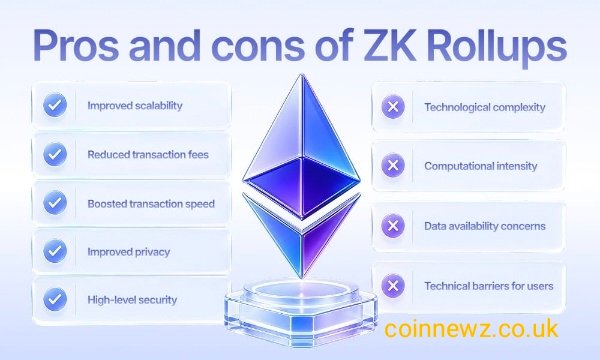
There are engineering trade-offs involving:
- Proof-generation speed
- Hardware requirements
- Execution compatibility
- Decentralization
- Developer tooling
- Transaction throughput
- Security assumptions
The most successful solutions will likely be those that balance these competing requirements rather than optimizing only one metric.
4. ZK Proof Generation and Verification Are Becoming a Bigger Focus
The technology behind ZK rollups is mathematically powerful, but it is also computationally demanding.
Generating proofs can require substantial computational resources. As ZK networks grow, developers need proving systems that are faster, cheaper, more reliable, and easier to decentralize.
This is creating a growing market around specialized proving infrastructure.
Recent academic work also highlights the importance of verifying zkEVM implementations and ZK systems. A July 2026 research paper proposed an approach for automated formal verification of zkEVM implementations, reporting more than 90% bug detection in its benchmark while emphasizing that correctness of the underlying implementation remains critical.
Another recent 2026 study examined ZKP security tools across real-world vulnerabilities and found that existing tooling still leaves important gaps, particularly when moving from isolated targets to complete codebases.
These developments are highly relevant to the future of ZK rollups.
A validity proof is only as trustworthy as the system that generates and verifies it. Better formal verification, auditing, testing, and proof infrastructure could therefore become just as important as raw transaction throughput.
5. Security Is Becoming a Central Part of the ZK Rollup Conversation
Early discussions about Layer 2 technology often focused heavily on speed and transaction fees.
Today, security is receiving much more attention.
ZK rollups use validity proofs to establish that a batch of transactions follows the protocol’s rules. This differs from optimistic rollups, which generally assume transactions are valid unless an invalid state is successfully challenged.
That distinction is one of the major technical differences between the two approaches.
But ZK rollups are not automatically risk-free.
A complete security evaluation can involve:
- Smart contract security
- Proof-system security
- Sequencer design
- Bridge contracts
- Upgrade mechanisms
- Data availability
- Key management
- Implementation correctness
- Withdrawal mechanisms
- Governance controls
This is why users should not judge a ZK rollup solely by its transaction-per-second claims.
A network may advertise extremely high throughput, but users also need to understand how the system handles failures, upgrades, censorship, data availability, and emergency situations.
The broader 2026 ZK ecosystem is increasingly focused on these questions.
6. ZK Rollups Are Moving Beyond Simple Transaction Scaling
Perhaps the most interesting long-term development is that ZK technology is no longer limited to the simple idea of “cheaper Ethereum transactions.”
Zero-knowledge proofs can verify computation without requiring every participant to independently reproduce that computation.
That opens the door to applications involving:
- Decentralized finance
- Privacy-preserving applications
- On-chain gaming
- Identity systems
- Tokenized assets
- Cross-chain verification
- Complex financial calculations
- Verifiable computing
- Enterprise applications
This broader use of ZK technology could eventually become more important than transaction fees alone.
For example, a financial application could theoretically perform complicated calculations away from Ethereum and submit a proof that the calculations were performed according to predetermined rules.
The blockchain would not necessarily need to repeat every computational step.
This changes the role of Ethereum from a platform that executes everything itself into a platform that can increasingly verify computations performed elsewhere.
That is a powerful concept for blockchain infrastructure.
7. Competition Between Rollup Designs Is Intensifying
The Layer 2 ecosystem is not a single technology.
Optimistic rollups and ZK rollups use different approaches to scaling and verification. Optimistic systems generally rely on fraud or fault-proof mechanisms, while ZK rollups use validity proofs.
ZK rollups have an important theoretical advantage because a valid proof can establish correctness without waiting for a traditional challenge period.
However, ZK systems can be more technically complex.
Optimistic rollups have historically benefited from comparatively simpler development models and strong ecosystem adoption. ZK rollups, meanwhile, continue improving proof-generation systems, Ethereum compatibility, and developer tooling.
This competition is healthy for the broader Ethereum ecosystem.
Instead of one solution controlling the entire Layer 2 market, developers can choose architectures based on the needs of their applications.
Over time, some networks may specialize in payments, others in DeFi, gaming, enterprise applications, or high-frequency transactions.
That could create a more diverse Ethereum Layer 2 landscape.
Why ZK Rollup News Matters to U.S. Crypto Users
For users in the United States, ZK rollup development could have practical consequences.
Lower transaction costs can make smaller blockchain interactions more reasonable. Faster processing can improve the user experience. Better developer compatibility can increase the number of applications available on Layer 2 networks.
There is also a potential economic effect.
If decentralized applications become easier and cheaper to use, more users may interact with blockchain-based services without needing to understand the technical details behind Layer 2 infrastructure.
That is similar to how most internet users do not think about the underlying networking protocols when they open a website.
The same could eventually happen with blockchain scaling.
Users may simply see faster applications and lower fees while the complexity of ZK proofs remains behind the scenes.
ZK Rollups vs. Optimistic Rollups: What Is the Difference?
Understanding this comparison is essential for anyone following zk rollup news.
Optimistic rollups generally operate under an assumption that submitted transactions are valid unless someone successfully challenges an invalid state.
ZK rollups instead attach cryptographic validity proofs to state transitions.
That difference can affect withdrawal mechanisms, finality assumptions, infrastructure requirements, and system complexity.
ZK Rollups
ZK rollups typically provide:
- Validity proofs
- Strong mathematical verification
- Potentially faster finality
- High transaction throughput
- Lower Layer 2 transaction costs
- Increasing Ethereum compatibility
Optimistic Rollups
Optimistic rollups typically provide:
- Mature development ecosystems
- Simpler proof-generation requirements
- Fault-proof mechanisms
- Strong Ethereum integration
- Established developer adoption
Neither category automatically wins every use case.
The right technology depends on what an application needs.
What Could Happen Next in ZK Rollup Development?
The next phase of ZK rollup development could focus less on proving that the technology works and more on making it easy to use at massive scale.
Several areas deserve close attention.
Faster Proving
Proof generation needs to become faster and more economical.
Specialized hardware and improved proving algorithms could help networks process larger batches without creating excessive infrastructure costs.
Better Decentralization
Many Layer 2 systems still rely on specialized sequencers or infrastructure operators.
Increasing decentralization could improve censorship resistance and reduce dependence on individual operators.
Better Developer Experience
Developers need familiar tools, reliable documentation, debugging systems, testing frameworks, and compatible smart contract environments.
The easier it becomes to build on ZK networks, the more likely adoption will grow.
Improved Security Verification
Recent research demonstrates that formal verification and automated security tooling are becoming increasingly relevant to ZK systems.
As the value secured by ZK infrastructure increases, security standards will likely become more demanding.
More Real-World Applications
The strongest test for ZK technology will ultimately be adoption.
If ZK networks can support applications people actually use while maintaining security and affordability, the technology could become a fundamental part of blockchain infrastructure.
What Should Investors Watch in ZK Rollup News?
Anyone following the crypto market should avoid focusing only on token prices.
Technology development can provide more meaningful long-term information.
Important indicators include:
- Transaction activity — Are people actually using the network?
- Developer activity — Are developers building new applications?
- Total value secured — How much economic activity is taking place?
- Proof-generation costs — Is the technology becoming more efficient?
- Sequencer decentralization — Is control becoming more distributed?
- Security record — Has the network experienced major vulnerabilities?
- Ethereum compatibility — How easily can developers deploy applications?
- Interoperability — Can assets and applications interact across ecosystems?
- User experience — Are transactions genuinely fast and affordable?
- Sustainable economics — Can the network remain viable as usage grows?
These factors can provide a more complete picture than short-term market speculation.
FAQ’s
What is a ZK rollup?
A ZK rollup is an Ethereum Layer 2 scaling technology that processes transactions away from Ethereum Mainnet and uses cryptographic validity proofs to demonstrate that the resulting state transition is correct.
Why are ZK rollups important?
ZK rollups can increase transaction throughput while reducing the amount of computation and data that needs to be processed directly by Ethereum Mainnet. This can help make blockchain applications faster and more affordable.
Are ZK rollups better than optimistic rollups?
Not necessarily in every situation. ZK rollups offer validity proofs and potentially faster finality, while optimistic rollups have different technical trade-offs and established ecosystems. The best choice depends on the application’s requirements.
What is zkEVM?
A zkEVM is an environment designed to execute Ethereum-compatible smart contracts while using zero-knowledge proof technology. Its goal is to combine Ethereum developer compatibility with the scalability benefits of ZK systems.
Did EIP-4844 help ZK rollups?
Yes. EIP-4844 introduced blob data designed to provide cheaper data availability for rollups. Lower data costs can improve the economics of Layer 2 networks, including ZK rollups.
Are ZK rollups secure?
ZK rollups use cryptographic proofs to verify state transitions, but the overall security of a network also depends on its smart contracts, proof implementation, sequencer, bridge, upgrade system, and other components. Users should evaluate each network individually.
Final Thoughts:
The latest zk rollup news points toward a technology entering a more mature stage of development. ZK rollups are no longer discussed only as an experimental answer to Ethereum’s scalability problem. They are becoming part of a broader infrastructure strategy involving cheaper transactions, verifiable computation, zkEVM development, improved proving systems, and increasingly sophisticated decentralized applications.
The biggest opportunity may not simply be processing more transactions.
The deeper opportunity is allowing Ethereum to verify enormous amounts of computation without requiring the base layer to perform every operation itself.
At the same time, challenges remain. Proof generation needs to become more efficient, ZK systems need rigorous security verification, and Layer 2 networks need to continue improving decentralization and user experience.
For anyone tracking Ethereum and blockchain technology in the United States, these developments make zk rollup news an important area to watch throughout 2026.
The networks that combine scalability, security, developer accessibility, decentralization, and sustainable economics could play a significant role in determining what the next generation of Ethereum applications looks like.
Meta Description:
Explore the latest zk rollup news, 7 powerful Ethereum scaling trends, zkEVM advances, security updates, and what to watch in 2026.