
Why Is Bitcoin Price Up Today? BTC Rally Explained
If you are searching why is Bitcoin price up today, the short answer is that Bitcoin’s recent rally has been supported by several factors at the same time rather than one single headline.
The biggest confirmed drivers include strong U.S. spot Bitcoin ETF demand, renewed institutional participation, a weaker U.S. dollar, changing Treasury-market conditions, improving sentiment around U.S. crypto regulation and a powerful technical move that appears to have been amplified by short covering.
The timing matters. Bitcoin rose sharply during the U.S. trading week ending August 21, 2026, when Reuters reported that BTC reached a three-month peak while the dollar fell and Treasury yields remained a major focus for investors. Reuters also reported that Bitcoin gained nearly 20% during the week.
However, Bitcoin trades around the clock. Conditions can change quickly, particularly over a weekend when U.S. ETF markets are closed but BTC continues trading. The reasons supporting the rally today could therefore look different by the next U.S. trading session.
Why Is Bitcoin Price Up Today?
The current Bitcoin rally is best understood as a combination of crypto-specific demand and broader macroeconomic factors.
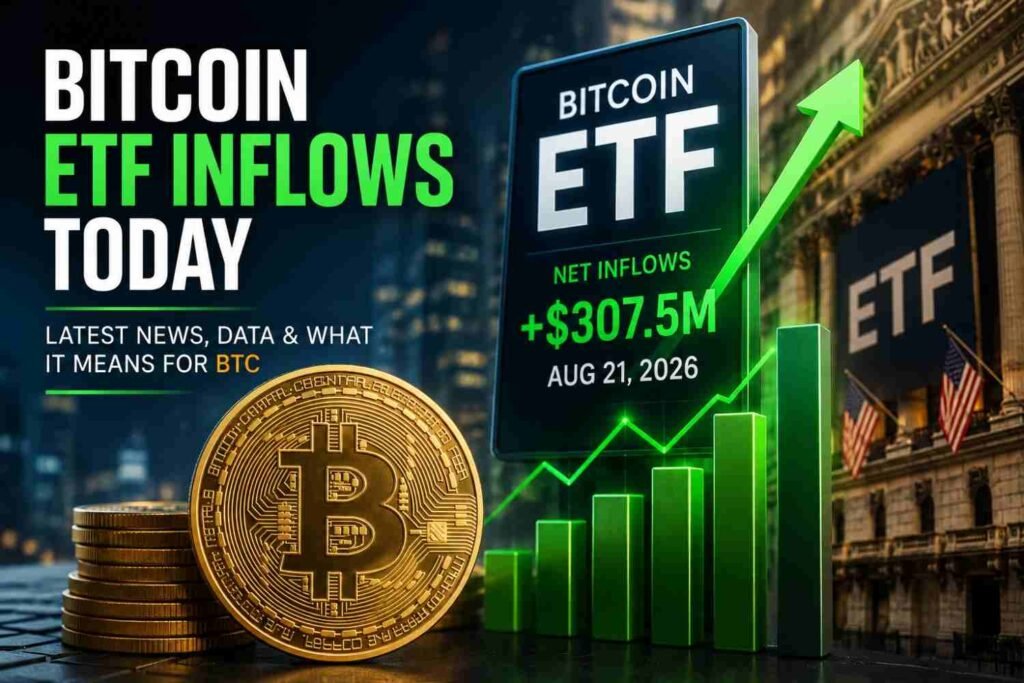
One of the clearest pieces of evidence is the recent activity in U.S. spot Bitcoin ETFs. Farside’s ETF-flow data shows that U.S. spot Bitcoin ETFs recorded a $606.3 million net inflow on August 20, 2026, with BlackRock’s IBIT accounting for approximately $503.0 million of that day’s inflows. The following trading day, August 21, recorded another $307.5 million of net inflows.
Those flows matter because spot Bitcoin ETFs give traditional investors access to Bitcoin through exchange-traded investment products. Strong inflows can represent meaningful demand for BTC exposure, although ETF flows alone do not prove that they caused every part of the price increase.
The macroeconomic backdrop has also changed.
Reuters reported on August 21, 2026, that the U.S. dollar fell to a three-month low amid concerns about the Treasury Department’s expanded buyback program for longer-dated government debt. At the same time, the 30-year Treasury yield reached its highest level since 2007. Bitcoin was also trading near a three-month high.
This relationship should be interpreted carefully. A weaker dollar can make dollar-denominated alternative assets more attractive, while changing expectations around liquidity and interest rates can affect investor appetite for riskier assets. But that does not mean the Treasury announcement mechanically caused Bitcoin’s entire rally.
Another possible amplifier was short covering. When traders holding bearish positions are forced to close them as prices rise, they may need to buy Bitcoin or related instruments. That additional buying can accelerate an already strong move.
Regulatory optimism has also contributed to market sentiment. Reuters reported on August 19, 2026, that President Donald Trump called on Congress to pass legislation establishing clearer definitions for digital assets, while U.S. regulators continued working on crypto-market rules.
The important distinction is that regulatory optimism is not the same as enacted legislation. Investors should separate confirmed policy changes from proposals and political statements.

Bitcoin Price Today
Bitcoin’s price changes continuously because the cryptocurrency market operates 24 hours a day, seven days a week.
The latest quoted daily BTC/USD data available for August 22, 2026 showed Bitcoin around $77,192.59, with the day’s reported high near $78,767 and low near $76,628.
That figure should not be treated as a live price for August 23. BTC may trade at a materially different level by the time a reader opens this article.
For readers who want to follow the market rather than rely on a static article figure, the latest Bitcoin price today can be monitored separately.
The recent price action is more important than one isolated quote. Reuters reported that Bitcoin rose nearly 20% during the week ending August 21, making it one of the strongest weekly moves in the recent market.
Are Bitcoin ETFs Driving the Rally?
U.S. spot Bitcoin ETFs are clearly an important part of the current market story.
According to Farside’s Bitcoin ETF flow data, the U.S. spot ETF market recorded:
- August 20: $606.3 million net inflow
- August 21: $307.5 million net inflow
- August 20 IBIT: approximately $503.0 million net inflow
Farside’s table provides daily flows for the major U.S. spot Bitcoin ETF products, including IBIT, FBTC, BITB, ARKB and others.
The size and consistency of these flows are significant because ETFs provide a regulated and familiar investment structure for investors who do not want to purchase and custody Bitcoin directly.
BlackRock’s iShares Bitcoin Trust ETF (IBIT) is particularly important because it is one of the largest U.S. spot Bitcoin investment products. BlackRock’s official iShares information identifies IBIT as an exchange-traded product designed to provide investors with exposure to Bitcoin.
You can also read more about the relationship between BlackRock and Bitcoin in this Bitcoin price prediction and BlackRock analysis.
Still, it would be misleading to say that ETF inflows alone caused Bitcoin’s rally.
Markets are influenced by multiple variables simultaneously. During this move, ETF inflows occurred alongside dollar weakness, Treasury-market volatility, positive crypto-policy developments and strong technical momentum.
That means the best conclusion is that ETF demand supported and potentially amplified the rally rather than proving it was the sole cause.
Is Institutional Demand Increasing?
Recent ETF flows provide evidence of strong demand through institutional-accessible investment products.
Institutional Bitcoin exposure can come through several channels, including:
- Spot Bitcoin ETFs
- Asset managers
- Investment funds
- Corporate treasury strategies
- Professional trading firms
- Custody and brokerage platforms
The advantage of the ETF structure is that investors can obtain Bitcoin exposure within traditional financial-market infrastructure.
The recent IBIT flows are particularly notable because BlackRock is one of the world’s largest asset managers. However, an ETF inflow does not reveal exactly who purchased every share or whether those investors intend to hold Bitcoin for months, years or only a short period.
Therefore, it is more accurate to say that institutional-accessible demand has been strong than to claim that every major institution is aggressively accumulating Bitcoin.
This distinction is important for understanding the Bitcoin market.
If ETF inflows remain positive while Bitcoin holds higher price levels, it could provide evidence that demand is continuing to absorb available supply. If inflows reverse into sustained outflows, the market could lose an important source of support.
Is the U.S. Dollar or Federal Reserve Affecting Bitcoin?
The U.S. dollar and Treasury market have become important parts of the current Bitcoin narrative.
Reuters reported on August 21 that the dollar fell to a three-month low as investors assessed the Treasury’s expanded buyback plans for longer-dated government debt. Reuters also reported that the 30-year Treasury yield reached its highest level since 2007.
The relationship between Bitcoin and the dollar is not perfectly consistent, but dollar movements can influence investor behavior across global markets.
When the dollar weakens, some investors may become more interested in alternative stores of value or assets with limited supply. Bitcoin can benefit from that environment, although there is no guarantee that the relationship will persist.
Treasury yields are another important variable.
Higher yields can make traditional fixed-income assets more attractive and can tighten financial conditions. Lower yields, depending on why they fall, can support greater appetite for risk assets.
The Federal Reserve remains relevant because interest-rate expectations influence Treasury yields, the dollar and overall liquidity conditions.
But the latest Bitcoin rally should not be described as simply a Federal Reserve-driven rally. Reuters’ recent coverage shows that investors are simultaneously responding to Treasury policy, currency movements, inflation concerns and expectations around future monetary policy.
The key takeaway is that Bitcoin is responding to a broader financial environment rather than one isolated Fed announcement.
Is Bitcoin Breaking Out Technically?
Bitcoin’s recent price structure has become significantly stronger.
During the week ending August 21, Bitcoin reached a three-month high around the $79,000 area, according to market reporting. Reuters described Bitcoin as having risen nearly 20% during the week.
That makes the recent high an important technical reference point.
For traders watching the market, several signals are worth monitoring:
- Whether BTC can hold above recent breakout levels
- Whether buyers defend pullbacks
- Whether trading volume expands during advances
- Whether Bitcoin continues forming higher highs and higher lows
- Whether the market can challenge the recent $79,000-plus area again
A move above a previous high accompanied by strong volume can strengthen the technical picture. A sharp rejection followed by declining volume can indicate that momentum is weakening.
However, technical momentum does not guarantee the next move.
Bitcoin can break above resistance and then reverse if macroeconomic conditions change or if traders begin taking profits.
Could Bitcoin Keep Rising?
Bitcoin could continue higher if the conditions supporting the recent rally remain in place.
The most important bullish scenario would involve continued demand from U.S. spot Bitcoin ETFs. If investors continue allocating money to products such as IBIT and other spot ETFs, that could provide ongoing demand.
Institutional participation would also be supportive if it remains strong.
Another positive factor would be a stable or weaker U.S. dollar combined with improving financial conditions. If investors become more comfortable with risk assets and liquidity conditions remain supportive, Bitcoin could benefit.
Regulatory clarity could provide another tailwind. Recent U.S. political and regulatory developments show continued efforts to establish clearer crypto-market rules, although proposed legislation still needs to be distinguished from legislation that has actually become law.
Technical momentum is another possible catalyst. If Bitcoin successfully retests recent highs and buyers remain active, momentum traders may continue participating.
But these are possible scenarios, not predictions or guarantees.
What Could Cause Bitcoin to Fall Again?
Bitcoin’s rally could reverse if the underlying demand weakens.
One obvious risk is ETF outflows. If investors begin withdrawing capital from spot Bitcoin ETFs, the market could lose an important recent source of demand.
Profit-taking is another risk. After a sharp weekly advance, some traders may decide to lock in gains. This can create selling pressure even if Bitcoin’s longer-term fundamentals have not changed.
Macro conditions could also turn less favorable.
Potential negative catalysts include:
- A stronger U.S. dollar
- Higher Treasury yields
- Less supportive liquidity
- More hawkish Federal Reserve expectations
- Negative crypto-regulation developments
- Weakness across broader risk assets
- Heavy leveraged long positions
- Large-scale liquidations
The recent rally itself can increase short-term risk because traders may become more heavily leveraged after prices rise quickly.
A strong Bitcoin rally therefore does not automatically mean that the next move will be higher.
Bitcoin Price Prediction vs Today’s Price Move
A current Bitcoin price move and a long-term Bitcoin price prediction are two different things.
Today’s price tells us what buyers and sellers are doing in the present market. A prediction attempts to estimate what BTC might do in the future based on assumptions about demand, liquidity, regulation, economic conditions and market structure.
A one-day or one-week rally cannot by itself prove that Bitcoin has entered a permanent long-term uptrend.
Likewise, a short-term decline does not automatically invalidate a longer-term bullish thesis.
Readers interested in understanding the difference can review this guide to Bitcoin price prediction.
The most useful approach is to treat forecasts as scenarios rather than certainties.
What Should Bitcoin Investors Watch Next?
The next phase of the Bitcoin rally will depend on whether the current supporting factors continue.
Here are the most important indicators to monitor:
- Bitcoin ETF flows — Watch daily U.S. spot ETF inflows and outflows. Farside’s data is useful for tracking the major products.
- BTC trading volume — Strong price movements supported by healthy volume can provide more confirmation than moves occurring on thin liquidity.
- U.S. dollar — Continued dollar weakness could remain supportive for Bitcoin, while a sharp dollar rebound could create pressure.
- Treasury yields — Long-term Treasury yields remain important for overall financial conditions.
- Federal Reserve expectations — Inflation, employment data and Fed communication can quickly change rate expectations.
- Regulatory developments — Watch actual legislation and official regulatory actions rather than relying solely on headlines.
- Institutional activity — ETF flows can provide one measurable indicator of demand through traditional investment channels.
- Support and resistance — The recent $79,000-plus area is an important technical reference after the latest rally.
- Broader risk sentiment — U.S. stocks, gold, bonds and other risk assets can help show whether Bitcoin’s move is part of a wider market trend.
Key Takeaways
- Bitcoin’s latest rally is being driven by multiple factors, not one confirmed event.
- U.S. spot Bitcoin ETFs recorded a $606.3 million net inflow on August 20, 2026 and another $307.5 million on August 21, according to Farside.
- BlackRock’s IBIT was responsible for approximately $503 million of the August 20 inflow.
- Reuters reported that the U.S. dollar fell to a three-month low while Bitcoin reached a three-month peak during the week ending August 21.
- Bitcoin’s weekly gain was close to 20%, making the move unusually strong.
- Treasury-market developments and changing expectations around liquidity and interest rates have contributed to the broader market backdrop.
- U.S. crypto-regulation developments have improved sentiment, but proposed rules should not be confused with enacted legislation.
- Bitcoin remains highly volatile, and ETF outflows, stronger dollar conditions, rising yields or profit-taking could reverse the rally.
Frequently Asked Questions
1. Why is Bitcoin price up today?
The recent Bitcoin rally has been supported by strong U.S. spot Bitcoin ETF inflows, institutional-accessible demand, dollar weakness, Treasury-market developments, improving crypto-regulation sentiment and strong technical momentum. These factors occurred together during the week ending August 21, 2026.
2. Is Bitcoin going up because of ETF inflows?
ETF inflows appear to be an important contributor, but they should not be described as the only reason Bitcoin is rising.
U.S. spot Bitcoin ETFs recorded $606.3 million of net inflows on August 20 and $307.5 million on August 21.
At the same time, Bitcoin was benefiting from broader macro and market factors. Therefore, ETF flows are better described as one important source of demand rather than the sole cause.
3. Is BlackRock buying Bitcoin?
BlackRock operates the iShares Bitcoin Trust ETF, commonly known by its ticker IBIT. Farside’s ETF-flow data shows approximately $503 million of net inflows into IBIT on August 20, 2026.
However, an ETF’s inflow does not necessarily mean BlackRock itself is making a directional Bitcoin investment with its own corporate balance sheet. Investors are buying shares of the fund, while the fund structure provides exposure to Bitcoin.
4. Can Bitcoin continue rising?
Yes, Bitcoin could continue rising if ETF inflows remain strong, institutional demand continues, macro conditions remain supportive and BTC maintains its technical momentum.
However, none of these conditions guarantees further gains. Markets can change quickly.
5. Should I buy Bitcoin after it goes up?
A recent price increase alone does not determine whether Bitcoin is suitable for an individual investor.
Bitcoin can experience large gains and equally significant declines. Investors should consider their own financial situation, risk tolerance and investment horizon and should not treat this article as personalized investment advice.
6. What factors affect Bitcoin price today?
Bitcoin can be affected by ETF flows, institutional demand, the U.S. dollar, Treasury yields, interest-rate expectations, Federal Reserve policy, regulation, liquidity, derivatives positioning, trading volume and broader risk sentiment.
Because these factors interact, it is usually difficult to attribute a short-term Bitcoin move to one cause with certainty.
7. Is Bitcoin price prediction reliable?
Bitcoin price predictions are not guaranteed. Forecasts depend on assumptions about future demand, liquidity, regulation, monetary policy and investor sentiment.
A forecast can be useful for considering possible scenarios, but it should not be treated as a certain future price.
Conclusion
So, why is Bitcoin price up today?
The evidence points to a combination of strong U.S. spot Bitcoin ETF demand, institutional-accessible buying, a weaker dollar, Treasury-market developments, improving U.S. crypto-regulation sentiment and powerful technical momentum.
The ETF data is particularly notable. U.S. spot Bitcoin ETFs attracted $606.3 million on August 20 and $307.5 million on August 21, while BlackRock’s IBIT accounted for approximately $503 million of the August 20 inflow.
At the same time, Reuters reported that Bitcoin reached a three-month high as the dollar weakened and investors focused heavily on U.S. Treasury-market developments.
But correlation is not the same as causation. No single factor explains the entire rally, and today’s bullish conditions can change quickly.
For that reason, the most useful way to view the current Bitcoin market is not as proof that BTC must keep rising, but as a market where ETF demand, macroeconomic conditions, regulation and technical momentum are currently interacting in a favorable way.
Financial risk disclaimer: Bitcoin and other cryptocurrencies are highly volatile and can result in substantial losses. This article is provided for informational and educational purposes only and does not constitute personalized investment, financial or trading advice.