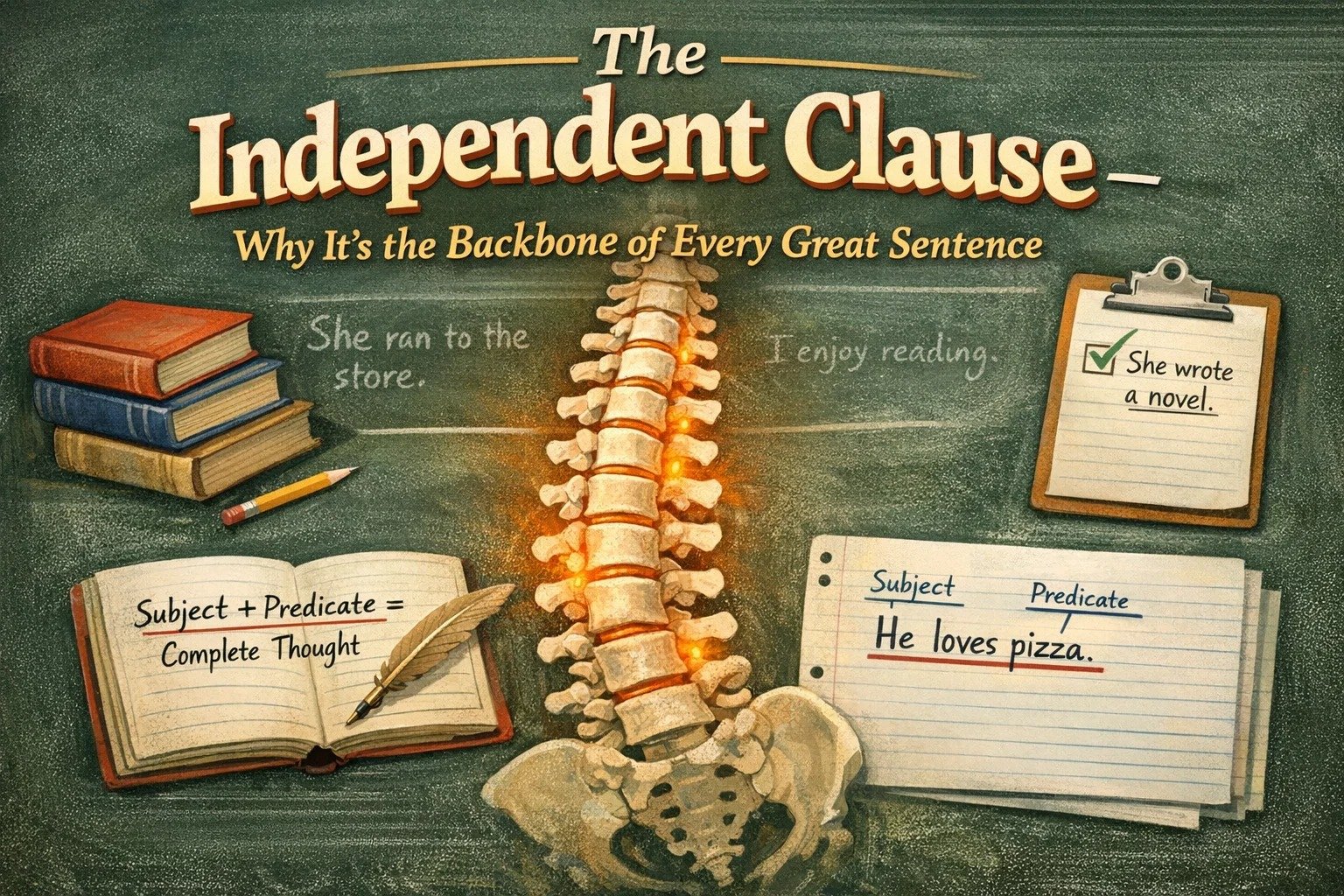
The Independent Clause – Why It’s the Backbone of Every Great Sentence
Let’s be honest for a moment. Most of us never think about grammar until something looks wrong on the page. You read a sentence back, and it feels incomplete—like a chair missing a leg. Or you string too many ideas together and end up with a breathless, confusing mess. The solution to both problems often comes down to one fundamental building block:
the independent clause. This isn’t just a dusty term from your middle school English textbook. Understanding the independent clause is like learning to see the skeleton inside a body. Once you know where the bones are, you can understand how everything moves, breathes, and makes sense.
So what exactly is an independent clause? In plain English, it’s a group of words that contains a subject and a verb and expresses a complete thought.
That last part is crucial. A complete thought can stand alone as a sentence. No crutches. No “but wait, what about…” If someone walked up to you and said only those words, you’d understand them perfectly. For example: “The dog barked.” That’s a full independent clause. Subject? Dog. Verb? Barked. Thought complete. When you master this concept, you stop guessing where commas go or why your paragraphs feel choppy. You start writing with confidence, clarity, and a rhythm that keeps readers hooked.
Breaking Down the Independent Clause – Subjects, Verbs, and Complete Thoughts
Before we go any further, let’s get our hands dirty with the actual pieces. Every independent clause must have a subject. The subject is the who or what doing the action or being described. It could be “the rain,” “my youngest cousin,” “that rusty bicycle,” or simply “she.” Without a subject, you have a fragment, not a clause.
The second mandatory piece is a predicate, which always includes a verb. The verb shows action (run, think, build) or a state of being (is, seem, become). Put them together, and you get a core like “Birds fly.” That’s two words, one period, one complete idea. That’s the magic of the independent clause in its purest form.
But here’s where it gets interesting. An independent clause can be short and punchy, or it can stretch out with extra details and remain independent.
For instance, “The old man with the crooked cane and the faded hat walked slowly to the corner store” is still a single independent clause. Why? Because it has one subject (“man”) and one verb (“walked”). All that extra description is just decoration. The clause doesn’t need another clause to finish its business. That ability to stand alone is the test. If you can put a period after it and feel satisfied, you’ve nailed it. If you feel a nagging sense that something is missing, you probably have a dependent clause on your hands, which is a whole different creature.
Why the Independent Clause Matters More Than You Think in Everyday Writing
You might be thinking, “Okay, but I’m not trying to be a novelist or a grammar professor. Why should I care about the independent clause?” Fair question. The answer is that every time you write an email to your boss, a caption for social media, a report for a client, or even a text to a friend, you are assembling clauses. If you assemble them poorly, your meaning gets muddy. People misread you, ask for clarification, or simply tune out.
The independent clause is your tool for delivering clear, confident statements. When you write “The meeting is at 2 PM,” that’s an independent clause. No confusion. No follow-up question needed. That’s power.
Moreover, mixing independent clause structures creates rhythm. Read two short ones in a row: “The car wouldn’t start. I called a tow truck.” That’s direct and urgent. Now combine them with a comma and a conjunction: “The car wouldn’t start, so I called a tow truck.” That’s smoother and shows cause and effect. Professional writers switch between these patterns instinctively.
But you can learn to do it deliberately. Once you recognize the independent clause as your basic unit of meaning, you stop writing by accident and start writing by design. You also avoid two of the most common errors in English: the run-on sentence and the sentence fragment. Both are just failures of clause management.
Independent Clause vs. Dependent Clause – Spot the Difference Like a Pro
This is where many writers get tripped up. A dependent clause also has a subject and a verb, but it does not express a complete thought. It leaves you hanging. Words like “although,” “because,” “if,” “when,” and “since” often turn an otherwise fine independent clause into a dependent one. Compare “I went home” (independent) to “Because I went home” (dependent).
The second one makes you ask, “Because you went home… what?” That’s the hallmark of dependency. The clause needs an independent clause to lean on. In the sentence “Because I went home, I missed the party,” the first part is dependent, and the second part (“I missed the party”) is the independent clause.
Why does this distinction matter for your writing? Because confusing the two leads to fragments. A fragment is a dependent clause pretending to be a full sentence. For example, “When the rain stopped.” That’s not a sentence. It’s a setup with no payoff. Your reader feels cheated. To fix it, attach an independent clause: “When the rain stopped,
we went for a walk.” Now the dependent clause has a partner. Learning to spot these pairs instantly improves your editing eye. You’ll start noticing fragments in your own drafts and in other people’s writing. The independent clause is the anchor. The dependent clause is the boat tied to it. Without the anchor, the boat drifts.
Simple vs. Compound Sentences – The Role of the Independent Clause
Let’s talk about sentence types, because this is where the independent clause really shines as a structural tool. A simple sentence contains exactly one independent clause and nothing else. “The cat slept.” That’s it. Short, direct, impossible to misunderstand. Simple sentences are great for emphasis, action scenes, or any time you want zero ambiguity.
But if you use too many in a row, your writing sounds like a children’s book. “The cat slept. The dog ran. The boy laughed.” Choppy. That’s where compound sentences come in. A compound sentence contains two or more independent clauses joined by a comma and a coordinating conjunction (for, and, nor, but, or, yet, so) or by a semicolon.
For example: “The cat slept, but the dog ran.” Two independent clauses (“The cat slept” and “the dog ran”) connected by a comma and “but.” Notice that each clause could stand alone.
That’s the rule. You can also use a semicolon: “The cat slept; the dog ran.” No conjunction needed, but the relationship between the two clauses should be close. The beauty of compound sentences is that they show balance, contrast, or sequence. They let you pack more information into one sentence without creating a run-on sentence. Mastering the independent clause means knowing when to keep clauses separate (simple) and when to link them (compound). Both are valid. Both are powerful. The choice depends on the rhythm you want.
Complex Sentences – How the Independent Clause Partners With Dependent Ones
Now we level up. A complex sentence contains one independent clause and at least one dependent clause. The dependent clause adds extra information—time, reason, condition, or contrast—but cannot stand alone. For instance: “Although she was tired, she finished the race.” The independent clause is “she finished the race.” The dependent clause is “Although she was tired.” Notice how the dependent clause sets a scene or a condition. It enriches the meaning without breaking the grammatical integrity of the sentence. You can put the dependent clause first or second. “She finished the race although she was tired” works just as well. The comma is optional when the dependent clause comes second.
Complex sentences are your friend when you need to show nuance.
They allow you to express cause-and-effect relationships, concessions, and time sequences without writing multiple short sentences. Compare: “It was raining. We played anyway.” That’s fine but blunt. Now try a complex sentence: “Even though it was raining, we played anyway.” The word “even though” ties the two ideas together into a single, flowing thought. The independent clause (“we played anyway”) remains the star. The dependent clause just adds context. Good writers mix simple, compound, and complex sentences to create a natural, engaging rhythm. Too many complex sentences in a row feel academic and heavy. Too few feel childish. The independent clause is your constant across all three.
Common Mistakes Writers Make With the Independent Clause
Let’s get practical. Even experienced writers trip over three specific errors involving the independent clause. The first is the run-on sentence, also called a fused sentence. This happens when you smash two independent clauses together with no punctuation or conjunction. Wrong: “I love coffee, it keeps me awake.” You have two complete thoughts (“I love coffee” and “it keeps me awake”) with no wall between them.
The fix is easy: add a period, a semicolon, or a comma plus a conjunction. Right: “I love coffee, for it keeps me awake.” Second, the comma splice. That’s when you use only a comma to join two independent clauses without a conjunction. Wrong: “I love coffee, it keeps me awake.” The comma isn’t strong enough. Use a period, semicolon, or add “for” after the comma.
The third mistake is the opposite problem: the sentence fragment. This happens when you treat a dependent clause or a phrase as if it were an independent clause. Wrong: “Because I was late.” That’s not a sentence. It begs the question: what happened? Right: “Because I was late, I missed the bus.” The independent clause (“I missed the bus”) completes the thought. Another classic fragment is the “-ing” phrase without a main clause: “Running down the street.” Running… what? Who? Add an independent clause: “The dog was running down the street.” See the difference? Each of these errors is easy to fix once you learn to identify your independent clauses. Read your draft out loud. If a sentence leaves you hanging or feels breathless, you likely have a clause boundary problem.
Using Semicolons and Conjunctions With Independent Clauses – A Clear Guide
Punctuation is not random. It’s traffic control for words. When you have two independent clauses that you want to keep in the same sentence, you have three legal options. Option one: period. That makes two sentences. Option two: comma plus a coordinating conjunction (for, and, nor, but, or, yet, so). Example: “She wanted to go to the concert, but she had no money.” Both sides of the comma are independent clauses.
The conjunction shows the relationship (contrast, in this case). Option three: semicolon. Example: “She wanted to go to the concert; she had no money.” The semicolon acts as a stronger pause than a comma but a weaker stop than a period. Use it when the two independent clauses are closely related in meaning, and you want to show that connection without a conjunction.
Here’s a pro tip: never use a semicolon with a conjunction. That’s overkill. “She wanted to go, but she had no money” is correct. “She wanted to go, but she had no money” is wrong. Also, avoid using a comma alone (the comma splice we already discussed).
And never use a conjunction without a comma unless the independent clauses are very short. “I came, I saw, I conquered” is a famous stylistic exception, not a rule. For everyday writing, follow the three options. Your readers will never notice your correct punctuation—which is the point. They’ll just feel that your writing flows smoothly. That smoothness comes from respecting the boundaries between independent clauses.
Table – Independent Clause vs. Dependent Clause at a Glance
| Feature | Independent Clause | Dependent Clause |
| Has a subject and a verb | Yes | Yes |
| Expresses a complete thought | Yes | No |
| Can stand alone as a sentence | Yes | No |
| Example | “The train arrived late.” | “Because the train arrived late” |
| Common starter words | None needed (can start with any subject) | Subordinators: although, because, if, when, since |
| Punctuation when alone | Ends with a period, question mark, or exclamation | Creates a fragment (error) |
| Role in a sentence | Main idea; can be the whole sentence | Adds detail; must attach to an independent clause |
This table gives you a quick reference. When you’re editing, ask yourself: Does this group of words leave me asking “so what?” If yes, it’s likely a dependent clause masquerading as an independent clause. Add an independent clause to rescue it. If it stands tall and complete on its own, congratulations—you’ve written an independent clause. Keep it, combine it, or let it shine solo.
How to Teach the Independent Clause to Students or Beginners
If you’re a teacher, tutor, or parent helping someone learn grammar, start with the simplest possible examples. Don’t lead with jargon. Write two short sentences on a board: “Birds sing.” “The sun rises.” Ask: Do these make sense alone? Yes. Those are independent clauses. Then write a fragment: “When birds sing.” Ask: Does that feel finished? No. Why? Because “when” makes you expect something else. This contrast is more powerful than any definition. Next, play a game: give the learner a list of clauses and ask them to mark each as independent or dependent. Use real-world examples. “I like pizza.” Independent. “Because I like pizza.” Dependent. “The game ended.” Independent. “After the game ended.” Dependent.
Once they can identify independent clauses, teach them to combine. Give them two independent clauses: “The movie was long. I enjoyed it.” Ask them to combine using a period (already done), a semicolon, or a comma plus “but.” Then introduce a dependent clause like “Although the movie was long,” and have them attach the independent clause “I enjoyed it.” This builds sentence variety. The goal is not to make everyone a grammar nerd. The goal is to give them a tool. When they say, “This sentence sounds weird,”
they can check their independent clauses. Is there one? Is there more than one without proper punctuation? That diagnostic skill is what separates fluent writers from frustrated ones. And it all starts with the independent clause.
Quotes About Clarity and the Power of the Independent Clause
“The sentence is the largest unit of grammar that we can feel confident about. And the independent clause is the sentence’s heartbeat.” — Martha Kolln, author of Rhetorical Grammar.
“Write with nouns and verbs, not with adjectives and adverbs. The independent clause gives you the noun-verb core. Everything else is seasoning.” — Adapted from Stephen King, On Writing.
“A writer who does not understand the independent clause will never truly understand the semicolon. And a writer who fears the semicolon will never write with full rhythmic power.” — Lynne Truss, Eats, Shoots & Leaves.
“When I edit my own work, the first thing I look for is the independent clause. If I can’t find it in two seconds, I rewrite the sentence.” — June Casagrande, grammar columnist.
These quotes aren’t just decoration. They come from people who have spent decades thinking about how language works.
The common thread is that the independent clause is foundational. You can break the rules once you know them. But you have to know them first. And knowing the independent clause is rule number one.
Practical Exercises to Master the Independent Clause Today
You want to get better at this? Then work with your own writing. Take a recent email, social media post, or paragraph from a report. Highlight every independent clause in one color and every dependent clause in another. You’ll likely find that you naturally write many independent clauses correctly. But you might also spot a fragment or a run-on. Fix them. Do this exercise five times,
and you’ll train your eye permanently. Another powerful exercise: take a long, confusing sentence from something you’ve written and break it into its component clauses. Write each independent clause on a new line as its own sentence. Then rewrite the original, but this time consciously choose how to join them.
A third exercise is imitation. Find a writer you admire—a journalist, a novelist, a blogger. Copy one of their paragraphs by hand. Then mark every independent clause. Notice how they mix short and long, simple and compound. Notice where they use a period, a semicolon,
or a comma with a conjunction. Imitation is not plagiarism; it’s how musicians learn scales and painters learn brushwork. The independent clause is your scale. Practice it for ten minutes a day, and within a month, your sentence-level craft will be unrecognizably better. You’ll stop guessing and start knowing. That’s the difference between an amateur and a pro.
The Independent Clause in Different Writing Styles – Academic, Business, and Creative
The rules of the independent clause don’t change, but how you apply them varies by context. In academic writing, you’ll use many complex sentences with dependent clauses that show logical relationships (“because,” “therefore,” “however”). Your independent clauses will often be long and packed with qualifications. That’s fine, but be careful not to lose the main idea.
Every independent clause should have a clear subject and verb, even if buried under jargon. In business writing, short to medium independent clauses are your friend. “The Q3 numbers are down. We need a new strategy.” Direct, honest, fast. Business readers want clarity, not poetry. Avoid run-ons and fragments because they look unprofessional.
Creative writing is where you can play. Novelists and short story writers will sometimes break the rules intentionally—using fragments for effect, stringing independent clauses with only commas to create a breathless feel, or writing one-word sentences for punch. But here’s the secret: they know the rules first. James Joyce’s run-ons are genius because he understood the independent clause so deeply that he could deform it with purpose.
If you break the rules by accident, you look like you made a mistake. If you break them on purpose, you look like an artist. Learn the independent clause so that you can choose when to honor it and when to bend it. That choice is what we call style.
How the Independent Clause Affects Readability Scores and SEO
This might surprise you, but the independent clause has a direct impact on how search engines and readability tools evaluate your content. Most readability formulas—like the Flesch-Kincaid Grade Level and the Gunning Fog Index—measure average sentence length and syllable count. But they also indirectly measure clause complexity. Sentences with too many independent clauses jammed together become run-ons, which score poorly.
Sentences with no independent clauses at all are fragments, which also score poorly. The sweet spot is a mix: about 60% simple and compound sentences (clear independent clauses) and 40% complex sentences (one independent plus one or two dependent clauses).
For SEO, Google’s algorithm does not directly check grammar. But it does track user engagement metrics like time on page, bounce rate, and return visits. If your sentences are confusing because you misuse independent clauses, readers will leave quickly. That signals low quality to Google.
On the other hand, clear, well-structured writing that respects clause boundaries keeps readers reading. They share your content. They link to it. That’s how you rank. So mastering the independent clause isn’t just about being a good writer. It’s about being a smart content strategist. Every time you correctly join or separate two independent clauses, you’re making your content more accessible to humans and more attractive to search engines.
Common Myths About the Independent Clause – Debunked
Let’s clear up some confusion. Myth one: “An independent clause must be short.” Not true. Length has nothing to do with independence. “The 19th-century steam locomotive, with its massive iron wheels and billowing black smoke, slowly pulled out of the station” is long but still one independent clause.
One subject, one verb. Myth two: “A sentence with a semicolon is too formal.” That’s a style preference, not a rule. Many bestsellers use semicolons. The real issue is whether the two independent clauses are closely related. If they are, a semicolon is elegant. If they aren’t, use a period.
Myth three: “You should never start a sentence with ‘and’ or ‘but’ starting an independent clause.” This is false. Starting a sentence with a conjunction is fine in modern English, especially in creative and business writing. It adds punch. “But I didn’t believe him.” That’s an independent clause starting with “but.” No problem. Myth four:
“Every sentence needs at least one independent clause.” Actually, no. Imperative sentences (“Sit down.”) have an implied subject (you), so they count. And some interjections (“Wow!”) are not clauses at all but still function as sentences. However, for most of your writing, sticking to independent clauses as your basic unit is a safe bet.
Conclusion:
We’ve covered a lot of ground. From the simple definition of the independent clause as a subject-verb unit expressing a complete thought, to the nuances of semicolons, conjunctions, and sentence types, to practical exercises and myth-busting. If you take away only one thing, let it be this: the independent clause is the smallest complete statement you can make in English. Everything else—dependent clauses, phrases,
modifiers—is optional decoration. When your writing feels off, go back to your independent clauses. Are they really independent? Are you joining them correctly? Are you accidentally creating fragments or run-ons? These are not minor technicalities. They are the difference between writing that confuses and writing that convinces.
The beauty of the independent clause is that it democratizes good writing. You don’t need a fancy vocabulary or a literature degree. You just need to learn one concept and practice applying it. Every email you send, every report you write,
every post you publish gets better the moment you start thinking in independent clauses. So here’s your challenge: for the next week, before you hit send or publish, scan your text for clause boundaries. Put a mental bracket around each independent clause. If you find two smashed together, fix them. If you find a fragment, attach it. Do that consistently, and you will become a clearer, more confident, and more persuasive writer. That’s not grammar for grammar’s sake. That’s power.
FAQ’s
Can an independent clause be just one word?
Yes, but only in very specific cases. A one-word independent clause requires a one-word sentence that implies both a subject and a verb. The most common example is an imperative command like “Go!” The subject “you” is implied, and the verb is “go.” Another example is “No!” as a response to a question, though that’s technically an interjection. For most practical purposes, however, your independent clause will need at least two words (a subject and a verb). “Run” alone is a fragment if you’re not issuing a command. “She runs” is a full independent clause. So while one-word versions exist, don’t rely on them in formal writing.
How do I know if a clause is independent or dependent when it starts with a word like “after”?
The word “after” is a subordinating conjunction. When you start a clause with “after,” “although,” “because,” “if,” “since,” “unless,” “until,” “when,” or “while,” you almost always create a dependent clause. The test is simple: read the clause alone. “After the movie ended” — does that feel complete? No. You expect to hear what happened after. That’s dependency. However, “after” can also be a preposition (“After the movie”) or an adverb (“He came after”). Context matters. But if “after” introduces a subject and a verb (“After the movie ended”), it’s a dependent clause. To make it an independent clause, remove the subordinating word: “The movie ended” is independent.
Can I have two independent clauses without any conjunction or semicolon?
Technically, no, that creates a run-on sentence or a comma splice, both considered errors in standard English. For example, “I like tea, I like coffee” is a run-on. “I like tea, I like coffee” is a comma splice. The correct options are: period (“I like tea. I like coffee”), semicolon (“I like tea; I like coffee”), or comma plus conjunction (“I like tea, and I like coffee”). That said, some respected authors use comma splices intentionally for a fast, flowing rhythm. But unless you are a published novelist with a strong stylistic voice, stick to the standard rules. Your readers will thank you.
What’s the maximum number of independent clauses you can put in one sentence?
There is no absolute maximum, but readability drops sharply after three independent clauses. Consider this: “I went to the store, and I bought milk, but I forgot eggs, so I went back, yet the store was closed.” That’s five independent clauses in one sentence. It’s grammatically legal (each comma has a conjunction), but it’s exhausting to read. Most style guides recommend limiting compound sentences to two or three independent clauses. If you have more than that, break them into multiple sentences or restructure using dependent clauses. Your goal is clarity, not a world record. One strong independent clause per sentence is often better than three mediocre ones crammed together.
Do questions count as independent clauses?
Yes, most questions contain at least one independent clause. For example, “Is it raining?” has a subject (“it”) and a verb (“is raining”) and expresses a complete thought. You don’t need anything else to understand the question. Even inverted word order doesn’t change its status as an independent clause. However, embedded questions like “I wonder if it is raining” contain a dependent clause (“if it is raining”) attached to an independent clause (“I wonder”). The question mark goes at the end of the whole sentence. So yes, standalone questions are perfectly fine independent clauses. They follow all the same punctuation rules: period or semicolon for statements, question mark for questions. Just don’t join two questions with a comma.